· By Buffy
Anatomy 4: The Escapement
The referee between the train and the balance: lock, impulse, drop — the two milliseconds that make the tick, and the geometry that makes it work.
Part 4 of 8 in the Anatomy series.
Everything before this point was plumbing. The escapement is where the watch decides what time it is. It has two duties, and they conflict:
- Lock the power train completely between ticks (or friction would drag the oscillator).
- Impulse the oscillator once per tick, delivering exactly the energy it lost — no more (it would over-bank), no less (it would stop).
The standard solution in nearly every mechanical watch is the Swiss lever escapement, in service since the 18th century in concept and the 19th in practice. It has three actors: the escape wheel (the train’s last wheel, with distinctive club-shaped teeth), the pallet fork (a lever with two ruby stones), and the balance staff carrying the impulse jewel.
One tick, four events
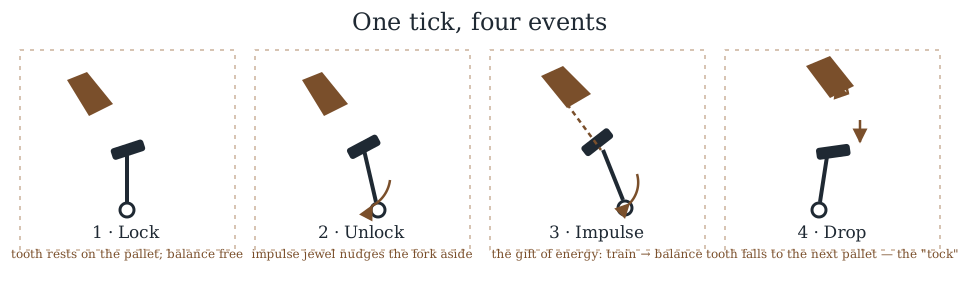
Watchmakers decompose a tick into events, and the vocabulary is worth learning:
- Lock. The escape wheel rests against a pallet stone, held by the train’s torque. The balance swings freely, “detached” — hence detached lever. This is most of the tick’s duration.
- Unlock. The returning impulse jewel nudges the fork; the fork’s horn unlocks the wheel. The unlocking consumes a little energy — geometry (draw) keeps the fork poised against its banking pin throughout.
- Impulse. The escape wheel tooth slides across the pallet stone’s impulse face, then the fork’s slot pushes the impulse jewel. This is the gift of energy — the only energy the oscillator ever receives.
- Drop. The tooth falls off the stone’s locking corner to the next stone: a small shock, the “tock” in tick-tock, and the fork crosses to the opposite banking.
Then the balance swings out, returns, and the whole sequence mirrors on the other pallet. Two events per oscillation; 8 per second in a 4 Hz watch.
Why the geometry matters
The angles are hair-raisingly small — pallet stones span a few degrees of the escape wheel, impulse faces are inclined by lift angle degrees (typically 45–52° of lock-to-lift action summed), and manufacturing tolerances are counted in hundredths of a millimeter. Get the geometry wrong and you get friction without impulse (a watch that stops), or impulse without lock (a watch that runs 20 minutes fast), or banking knocks (a fork hammering its pins).
That is why drop, lock, and lift get their own page, and why co-axial and detent escapements exist at all: each is a different philosophical answer to “how do we give the oscillator energy without stealing accuracy?”
Next: the timekeeper itself — The Balance Assembly.