· By Buffy
Anatomy 2: The Gear Train
Barrel to escape wheel: how a train of wheels turns one rotation an hour into one a minute, and why every ratio is a compromise with friction.
Part 2 of 8 in the Anatomy series.
A watch gear train is not a gearbox. A gearbox trades speed for torque to move a load; a watch train mostly exists to slow down a spring’s unwinding into useful, countable speeds — while losing as little energy as possible along the way.
The canonical layout
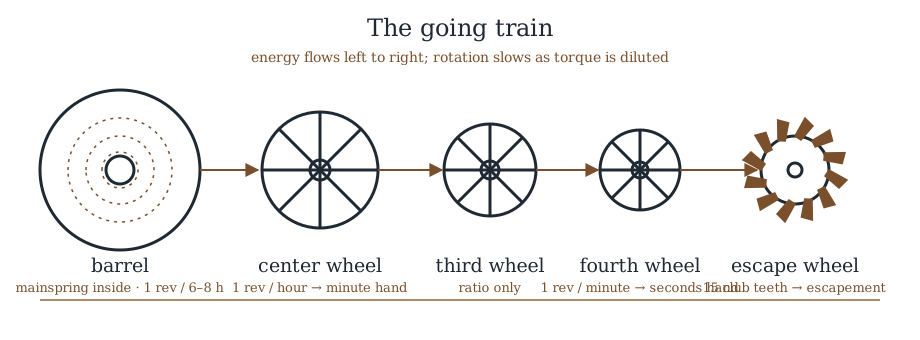
In a classic movement the wheels run:
barrel → center wheel → third wheel → fourth wheel → escape wheel
- The barrel turns once every 6–8 hours or so (it holds the mainspring).
- The center wheel turns exactly once per hour — the minute hand mounts on its arbor, poking through the dial.
- The third wheel is pure ratio, an idler with attitude.
- The fourth wheel turns exactly once per minute — the seconds hand. Small seconds at 6 o’clock is literally the fourth wheel’s extended pivot.
- The escape wheel hands energy to the escapement one tooth at a time.
Every wheel meshes with a pinion: a small, hardened steel leaf-gear on the next wheel’s arbor. A wheel driving a pinion is a reduction; the train’s counting is done by ratios (typically 72:1 from barrel to center in a manual movement) chosen so the hands turn at the right speeds.
Why not fewer, bigger wheels?
Friction. Every mesh and every pivot is a leak. The design goal is the fewest meshes that achieve the ratio, with the least sliding friction — which is why watch teeth are shaped like a cycloidal-ish rounded stub rather than the involute teeth of industrial gearing, and why pivots run in jeweled bearings.
The center-seconds problem
A fourth-wheel seconds hand lives at 6 o’clock. If you want seconds in the center, where a hand would pass over the cannon pinion, you need extra work: an indirect center seconds (an extra wheel driven off the fourth) or a direct drive (train redesigned so the fourth wheel is central). Both are compromises — indirect seconds can stutter when the hands are set, direct drive adds height. This is the sort of “trivial” detail that keeps watchmakers employed.
The cannon pinion: the train’s one intentional slip
The motion works must let you set the hands without forcing the whole train to spin against the escapement. The center wheel’s arbor therefore carries a cannon pinion mounted on a friction fit: tight enough to drive the hands, loose enough to slip when you turn the crown to set. That single controlled slip is why setting a watch feels like it has a detent, and why worn cannon pinions make watches “lose” their set time.
Next: where the energy comes from — The Mainspring and Barrel.